Mohamed Lekleti: Poussières d’exil
Current exhibition
Overview

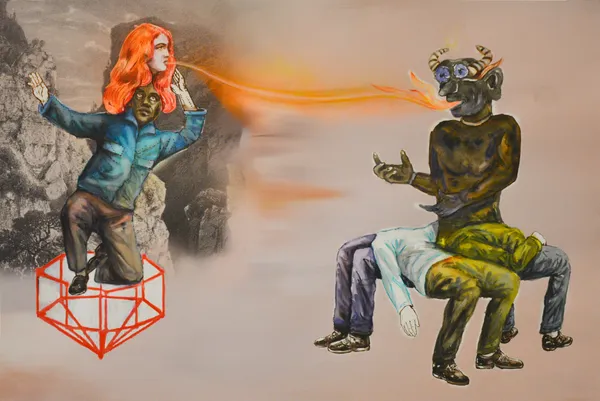
Mohamed Lekleti, Le Souffle des origines, 2026
lilia ben salah gallery is pleased to present Poussières d’exil, a solo exhibition by Mohamed Lekleti, curated by Eric Mangion, from March 19 to May 31, 2026.
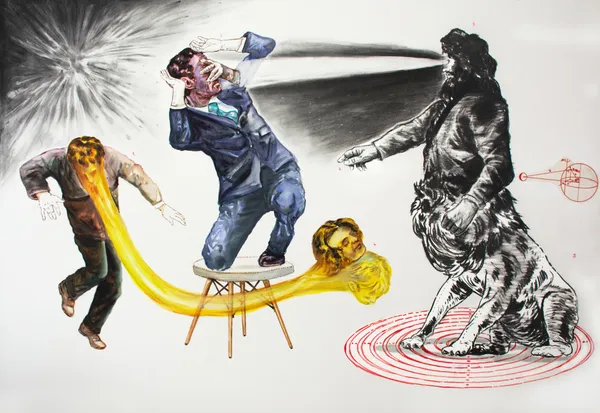
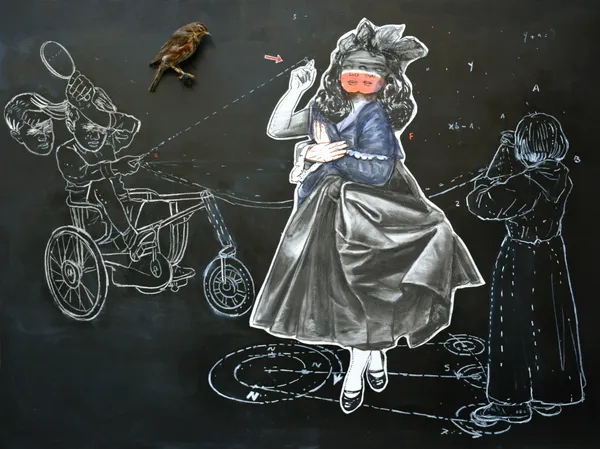
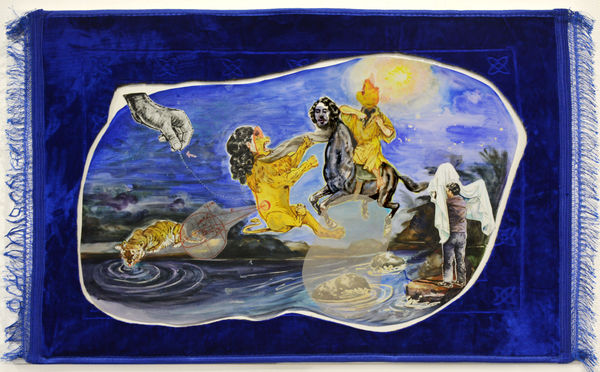
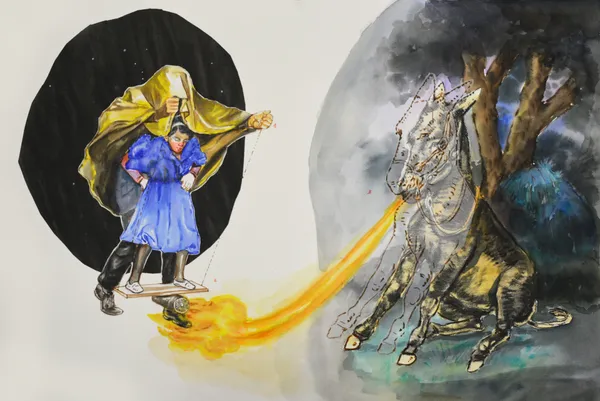
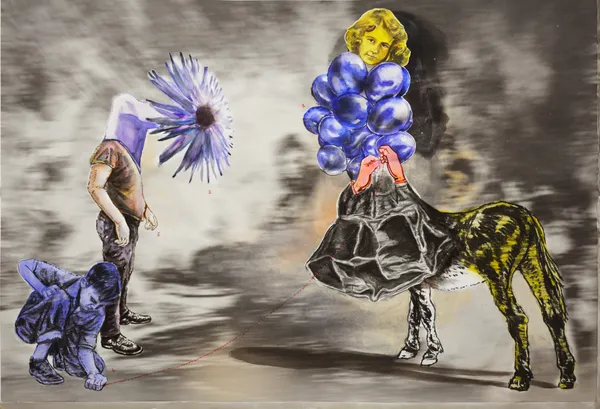
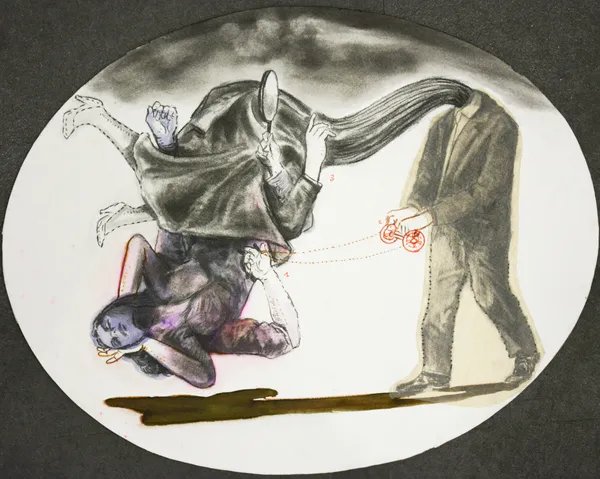
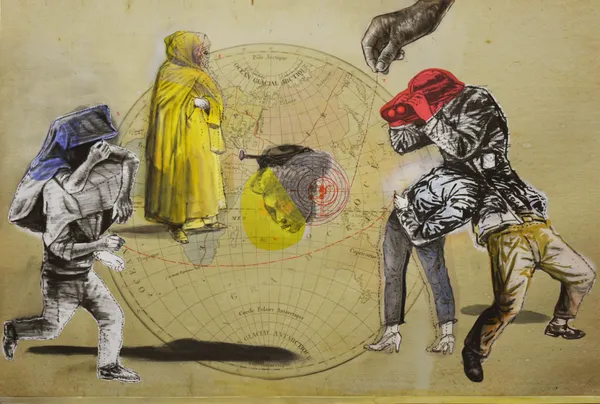
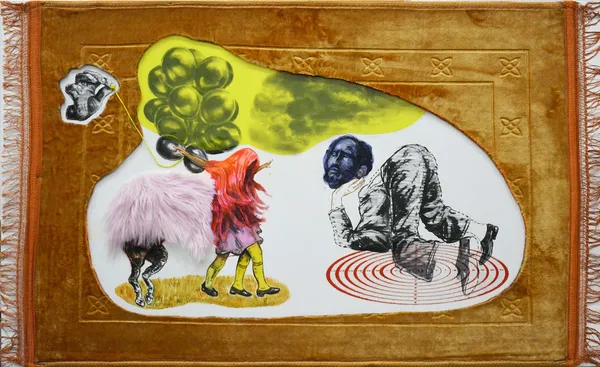
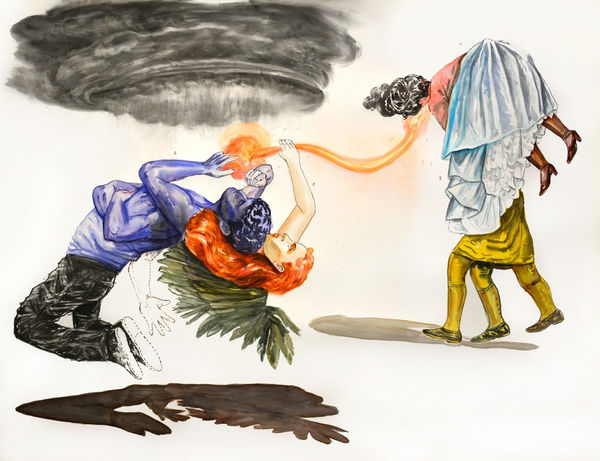
Mohamed Lekleti’s work is striking for its graphic dexterity, its sensitive mastery of painting, its ability to occupy space, and its use of objects: stuffed birds (in reference to The Conference of the Birds by Farîd-ud-Dîn ‘Attâr), ancestral Moroccan property deeds engraved in wood, wigs, African masks, or prayer rugs. His iconographic vocabulary gradually develops and diversifies: hands, threads, dark clouds, breaths, hybrid bodies (notably human/animal), twin bodies, bodies in tension, bodies off balance, doubled faces, targets, blurred images of war, circular machines, numbers, mathematical formulas, children, games, as well as migrants or men of power. He addresses subjects as crucial as domination, power, and the blindness of our gaze, depicting, like a psychoanalyst, our constant duality, our vagueness, our traumas, and our collective nightmares. Everything seems to appear in a state of suspension, as if all his drawings were held in a kind of weightlessness, made of fragility and precariousness, in which neither men nor women, nor animals nor objects touch the ground. For Mohamed Lekleti, the celestial world merges with the earthly world; the eternal and the factual meet, the timeless and the instant, the past and the present become one.
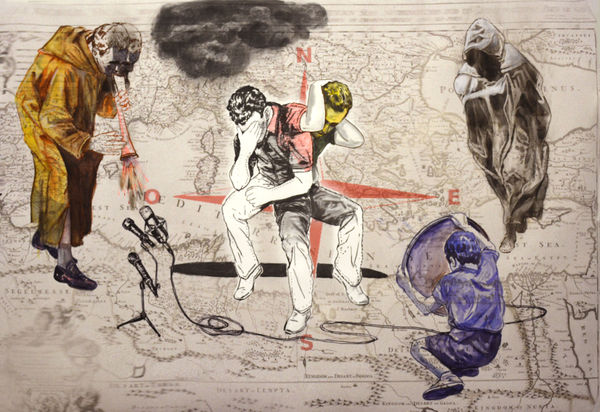
The exhibition at lilia ben salah gallery, his first monographic presentation, begins with a large mural drawing on the back wall (400 x 275 cm), then unfolds through a dozen drawings, old and new, with no apparent theme. Nevertheless, almost all of them evoke mechanisms of control or influence. Among the works on view, the most striking example is Poussière d’exil, 2022. Set against the background of a map of the Mediterranean – certainly dating from the 17th or 18th century, sourced from the web, digitized, printed, then mounted – we see a snake charmer (also with a double face) playing the flute in front of three microphones. The microphones are also recurring motifs in the artist’s work, metaphors for media discourse and its lures. The microphone cables are connected to a child who shields himself from the sound with a protective barrier, while at the center of the composition two Siamese men, seated on a compass rose with its four cardinal points, cover their eyes and ears with their elbows to cut themselves off from the world, its noise, and its turpitudes. A storm cloud dominates the scene, while a figure draped in a djellaba, faceless, armless, and with an unsettling appearance (evoking death lurking nearby) haunts the space. We sense here the attempt of three beings to escape the grip of a deeply ominous domination, a domination that does not speak its name and has no face. Yet the inevitably geopolitical presence of the Mediterranean (with all directions indicated: North / South / East / West) and the title help us to suppose that the tensions visible in the painting are those experienced by exiles, the uprooted, often forced to leave their land and to live in a deeply fragmented way (whose symptoms often resemble “voices” heard by patients) between two cultures and two languages.
Likewise, Emporte-moi vers la lumière, 2025, reveals a man wearing a flimsy paper crown like those found in Epiphany cakes, surrounded by an electrical cable connected to a woman’s head, an imaginary, almost unreal character. She evokes a mythological figure, a symbolic entity that guides, protects, or draws one toward the light. The man holds a thread also connected to a functionless machine, itself manipulated by two bodiless hands. Who manipulates whom in this image that resembles a parable? As always in Mohamed Lekleti’s work, everything is a visual riddle. We interpret more than we explain. Such is the world of his dreams.
— Eric Mangion
Exhibition curator
Exhibition curator
Works
-
 Mohamed Lekleti, Le Souffle des origines, 2026
 -
Mohamed Lekleti, L'oiseau souverain, 2019
-
Mohamed Lekleti, Polyphonies de Résistance, 2026
-
Mohamed Lekleti, Poussière d'exil, 2022
-
Mohamed Lekleti, Radieux dans la nuit sombre, 2026
-
Mohamed Lekleti, Les Liens de Feu, 2026
-
Mohamed Lekleti, Arrivés chez les veilleurs du Firdaws, 2026
-
Mohamed Lekleti, La trame des âmes flottantes, 2026
-
Mohamed Lekleti, Le fou se croit sage et le sage se reconnaît fou, 2023
-
Mohamed Lekleti, Emporte moi vers la lumière, 2025
-
Mohamed Lekleti, Un léger fil d’or vous rattache, 2025
-
Mohamed Lekleti, C'est un frais garçon- fils du roi d'à côté, 2025
-
Mohamed Lekleti, La Tête de Fleurs et les Secrets du Voyage, 2025
-
Mohamed Lekleti, Entre les dents de l’obscurité et les fruits de la lumière, 2026
-
Mohamed Lekleti, Reflet rose qui éclaire son visage, 2024
-
Mohamed Lekleti, Souffle de feu, 2022